Materials and Vertical Machining Centre: what works and what does not
Vertical Machining Centre is a milling machine with a vertical spindle and an automatic tool changer, run from a single programme. It is used for batch work on prismatic parts where several operations have to run without an operator. This entry explains what it is, what the numbers on a data sheet mean, and what to put on a drawing.
It is written from the point of view of the buyer and the drawing office: the values that are realistic in production, the ones that cost money, and the way the result is verified. Where an industry sets the requirement, oil and gas is used as the example: materials that work harden and still have to be certified.
What works with it
The material and the process are chosen together. For work involving Vertical Machining Centre the usual choice is 6082-T6 aluminium, for the reason that setups and tool changes, not the metal removal.
- %s – the default, because it balances cost, availability and machinability.
- Stainless grades – chosen where corrosion resistance or cleaning rules decide the material.
- Aluminium grades – chosen where weight or thermal conductivity matters more than strength.
- Engineering plastics – chosen where insulation, weight or chemical resistance is the point.
What to watch
Material behaviour changes the process before it changes the drawing. A grade that work hardens needs a different tool geometry and a different feed, and a certificate requirement such as in-house approval with dimensional reports has to be on the order before the bar is cut.
| Specification | Typical value |
|---|---|
| Work envelope | 800 x 500 x 500 mm |
| Spindle speed | 10,000 to 20,000 rpm |
| Rapid traverse | 36 to 48 m/min |
| Tool to tool time | 1.5 to 3 s |
| Positioning accuracy | ±0.005 mm |
| Pallet size | 800 x 500 mm |
Applications
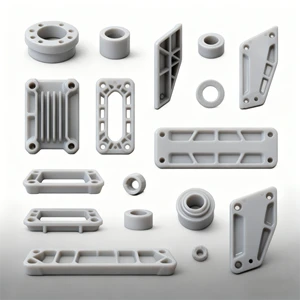
Vertical Machining Centre is used for batch work on prismatic parts where several operations have to run without an operator, and in practice it appears most often in enclosures, manifolds, bracket families, repeat production parts.
How it fits into a machining route
Vertical Machining Centre is one station in a route rather than the whole of it. The part arrives with the previous operation finished and leaves with the features it is responsible for completed, so the datum and the clamping method are agreed before the first part rather than discovered on it.The route is fixed before the first part is cut, and it is the route rather than the individual setting that holds the result: setups and tool changes, not the metal removal. Where a drawing calls for something the route cannot hold economically, that is raised at quotation rather than after the parts are made.
Standards, documentation and what is issued
The documentation requirement is in-house approval with dimensional reports. Material is supplied against a certificate where the application calls for it, inspection results are recorded with the job, and the records are kept so that a repeat order can be compared with the first instead of being measured from scratch.
CMM or height gauge against the drawing is the verification step. Where a customer format or a standard report is required, it is agreed before the batch starts, because a report written after the event is a report nobody can use.
Frequently asked questions
What tolerance should be specified for Vertical Machining Centre?
±0.01 mm is realistic in production. Tightening it beyond the functional requirement increases cost without improving the part.
Which material is usually used?
6082-T6 aluminium is the usual choice, supplied against in-house approval with dimensional reports.
How is the result verified?
CMM or height gauge against the drawing, with the results recorded so a repeat order can be compared with the first.
What is the most common mistake?
A fixture that swarf collects in, so the second part sits higher than the first.
How long does it take and what does it cost?
A realistic cycle is 10 to 30 minutes depending on the number of faces, and the cost driver is setups and tool changes, not the metal removal.
Related capability
If you are specifying Vertical Machining Centre on a drawing and want a second opinion on the route, send the model and the quantity. The first response is a manufacturability review with the likely risk points and a quotation, so the decision can be made on facts rather than on a price alone.
Machining, inspection and documentation are handled in one place, which is why the dimensional report and the material certificate arrive with the parts rather than after them.
Related entries
These entries sit next to Vertical Machining Centre in the encyclopedia: Coordinate Measuring Machine, CNC Drilling Machine, Sinker EDM. Reading them together gives a fuller picture of how the process, the material and the measurement affect each other.