Fixture Strategy for Knee Femoral Component: How We Held the Part
The fixture strategy behind a cobalt chrome or titanium femoral component for a knee replacement: how we located the part on its drawing datums, what was built, why those decisions were taken and how the setup performed in production.
The starting point
The customer asked us to machine a cobalt chrome or titanium femoral component for a knee replacement, and the drawing specified articulating surfaces polished below Ra 0.1 micrometres.
Before any toolpath was written we reviewed how many setups were unavoidable and whether the datums named on the drawing could be used for clamping rather than only for measurement.
Reading the datums
Locating from the features named as datums keeps machining and inspection in agreement, which removes an entire class of argument later.
Where the drawing datums were not reachable, we designed transfers rather than improvising on the machine.
What we built
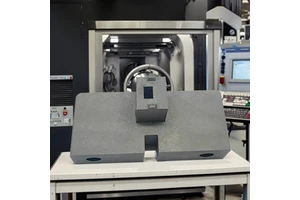
The fixture used hardened locating pins, positive side clamps and a support under every clamping point, so the part could be loaded one way only.
Fixture repeatability was checked by loading a part, indicating it, unloading and repeating the cycle several times before the first production piece.
Behaviour under load
Clamping points were placed directly above supports to avoid bending the part before the first cut, and cutting forces were kept towards the locators rather than towards the clamps.
This is the step that decides whether articulating surfaces polished below Ra 0.1 micrometres is achievable, and it is far cheaper to do here than to recover in inspection.
Result in production
The first article passed, and operator loading time settled at 7 minutes per part with no dependence on how hard the clamps were tightened.
The fixture is retained, labelled and rechecked at each reorder, so the second batch runs like the first rather than like a new project.
Summary
This programme now runs against an agreed process sheet, and repeat orders are released without a new round of proving.